
Cracking the Code: How Music Recommendation Engines Actually Work
A Guide To… Algorithmic Architecture of Streaming Platforms

The music industry has a fundamental problem; whilst streaming platforms process over a trillion data points daily to serve hundreds of millions of users, most labels and artists operate with surprisingly little understanding of how their music actually gets discovered. This isn't just an academic curiosity; it's a multibillion-dollar blind spot that's costing the industry countless opportunities for catalogue reactivation and sustainable audience development.
My research into the recommendation engines powering Spotify, Apple Music, Amazon Music, and YouTube Music reveals sophisticated systems far more nuanced than most industry professionals realise. These platforms don't simply shuffle songs randomly… They operate through complex multi-objective optimisation frameworks that balance competing priorities using advanced machine learning architectures processing billions of user behaviours monthly.
What started as curiosity about Spotify's algorithmic black box and data infrastructure evolved into a comprehensive analysis of how recommendation systems actually function, and more importantly, how strategic positioning within these systems can transform catalogue performance and long-term fan development.
The Spotify Discovery Is Beyond “The Algorithm"
Spotify doesn't use a single recommendation system. Instead, it operates through multiple interconnected surfaces, each optimised for distinct user contexts and business objectives. This realisation fundamentally changed how I understood music discovery.
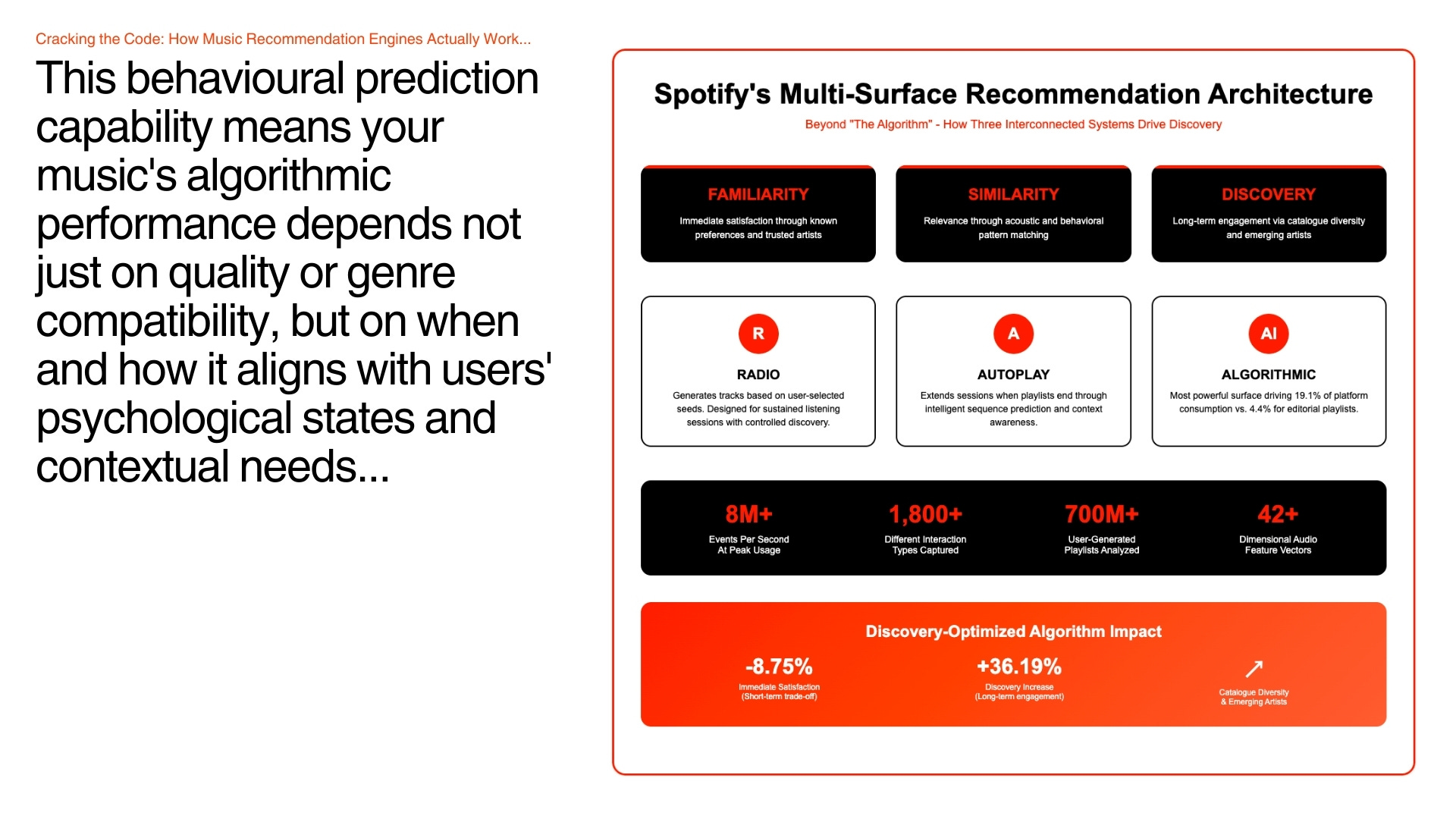
The platform's architecture consists of three primary recommendation surfaces: Radio generates tracks based on user-selected seeds (artists, albums, playlists), designed for sustained listening sessions where users want controlled discovery around familiar preferences. Autoplay activates when playlists end, extending sessions through intelligent sequence prediction. Algorithmic recommendations, the most powerful surface, drives 19.1% of total platform consumption compared to just 4.4% for editorial playlists...
The sophistication becomes apparent when examining how these systems balance what Spotify internally calls the "three pillars": familiarity (immediate satisfaction), similarity (relevance), and discovery (long-term engagement). Pure similarity-based recommendations create filter bubbles that damage user retention, whilst pure discovery overwhelms users and increases skip rates. The solution involves sophisticated multi-objective optimisation that simultaneously balances user satisfaction, discovery goals, and various business objectives including artist development and catalogue diversity.
Critically, Spotify's internal research demonstrates that discovery-optimised algorithms successfully shift consumption toward less popular artists and catalogue material. When their "OWA-SAT-Discovery" algorithm was tested, it reduced immediate satisfaction by 8.75% but increased discovery by 36.19% whilst significantly boosting streams to emerging and catalogue artists. The platform willingly accepts short-term engagement trade-offs to achieve long-term user retention and catalogue diversity.
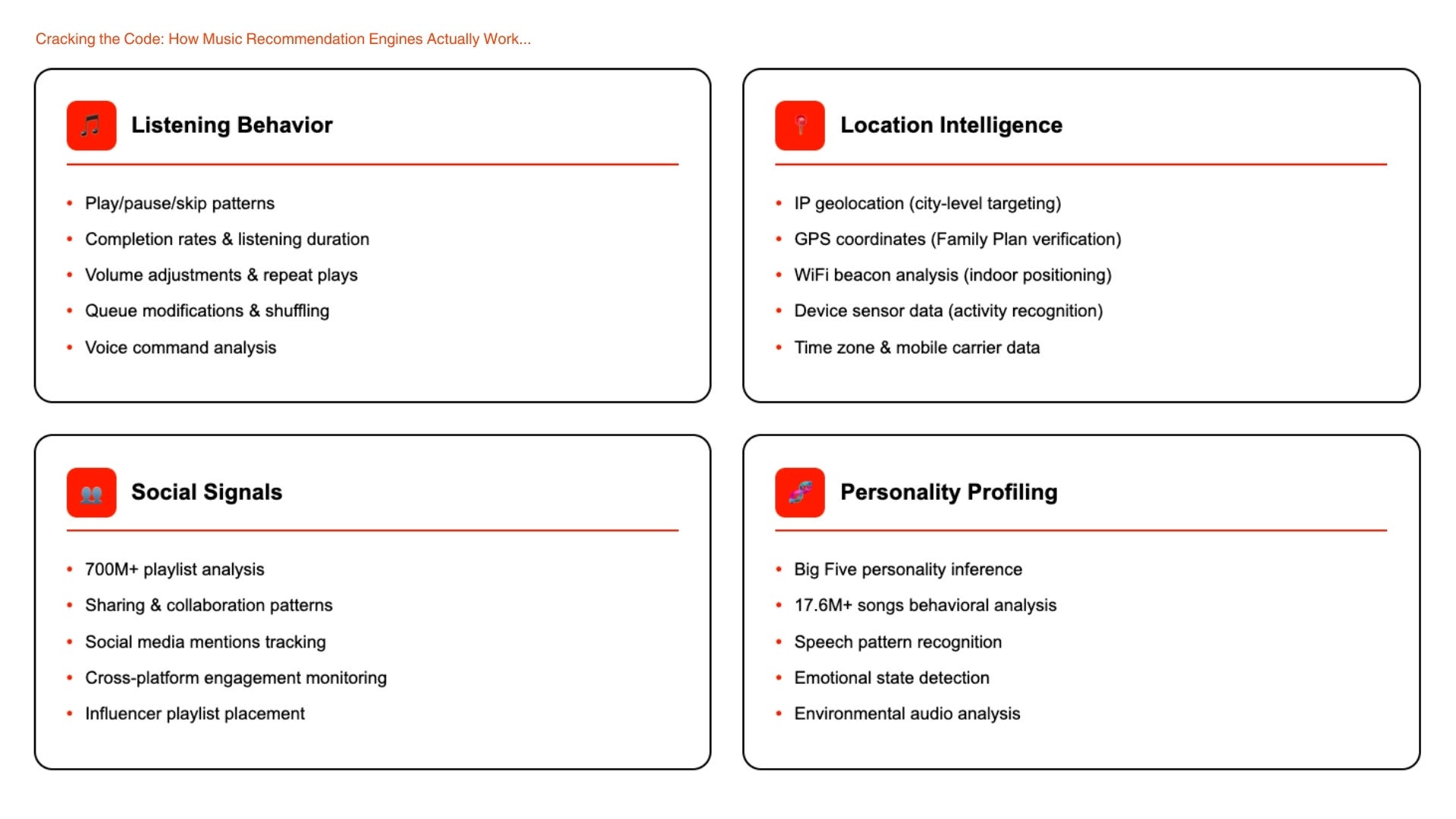
The recommendation sophistication depends on an extraordinary data collection apparatus that processes over 8 million events per second at peak usage, capturing 1,800+ different interaction types from basic play/pause actions to voice commands and environmental audio analysis.
Spotify employs multiple location tracking technologies simultaneously; IP geolocation for city-level targeting, device sensor data for activity recognition, and WiFi beacon analysis for indoor positioning. This enables features like automatic commute playlists and workout music that adapts to exercise intensity, but more strategically, it creates detailed behavioural profiles informing recommendation decisions.
The personality inference technology represents perhaps the most remarkable development. Spotify's patented system analyses listening behaviour to understand individual psychological profiles across the Big Five personality traits, processing patterns from 17.6 million songs to determine whether users are introverts or extroverts, open to experience or preferring familiarity. These psychological insights directly influence recommendation timing and content selection.
This behavioural prediction capability means your music's algorithmic performance depends not just on quality or genre compatibility, but on when and how it aligns with users' psychological states and contextual needs.
One aspect consistently underestimated by industry professionals is Spotify's sophisticated social signal integration. The platform analyses over 700 million user-generated playlists to identify preference patterns, but extends much deeper through what researchers term "social music discovery."
Research analysing 2.72 million link-sharing events reveals that music spread success depends on specific, measurable social factors: social tie strength (previous collaborative interactions between users), music taste compatibility (cosine similarity between user preference vectors), and social network context (whether the shared artist is already popular among the receiver's connections). The recent release of Spotify’s DM function will be an interesting addition to this multiplier.
These social signals feed back into the algorithmic recommendation system. When your music gets shared and engaged with, it doesn't just boost those specific users; it signals to the algorithm that the track has "social momentum" suitable for broader discovery amplification.
The strategic insight; music that performs well in social sharing contexts receives algorithmic amplification. This creates feedback loops where socially engaging music gets broader platform promotion, whilst music lacking social resonance becomes buried deeper in the catalogue.
Major Tech’s Battle For Your Attention
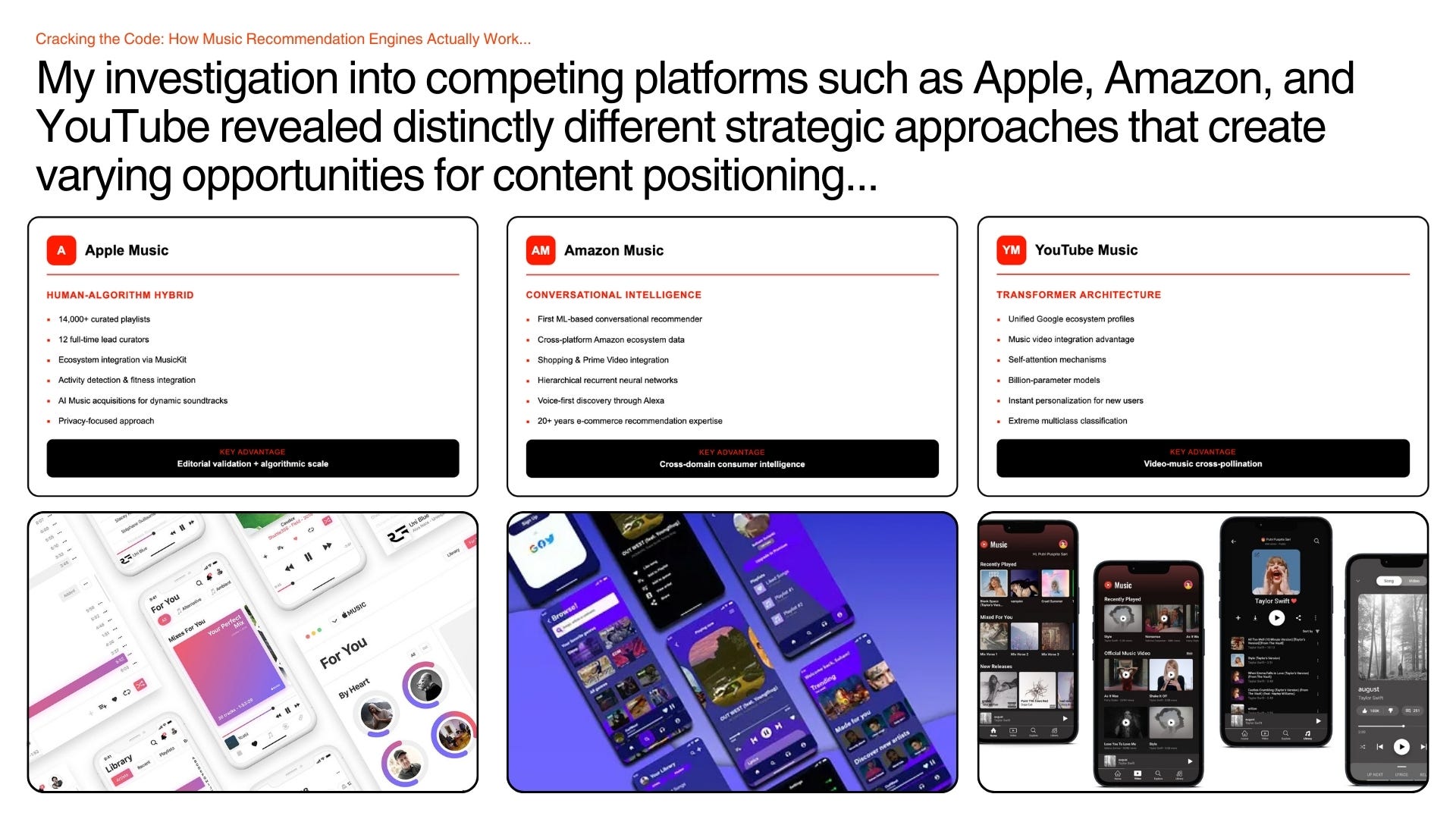
My investigation into competing platforms such as Apple, Amazon, and YouTube revealed distinctly different strategic approaches that create varying opportunities for content positioning.
Apple Music employs a sophisticated hybrid architecture uniquely emphasising human curation alongside algorithmic intelligence. The system maintains 14,000+ curated playlists with 12 full-time lead curators providing quality control and cultural intelligence. This creates opportunities for strategic playlist positioning that combines editorial validation with algorithmic amplification. The platform's ecosystem integration through MusicKit enables seamless connectivity across devices with context awareness for activity detection and fitness integration. Recent acquisitions of AI Music startups have enhanced dynamic soundtrack capabilities based on biometric feedback, creating new positioning opportunities for catalogue material aligned with specific activities or emotional states.
Amazon Music represents the industry's first customer-facing machine learning-based conversational recommender, building upon Amazon's two decades of e-commerce recommendation expertise. The system employs item-to-item collaborative filtering principles adapted for music through hierarchical recurrent neural networks combined with bandit-based exploration. Critically, Amazon Music uniquely leverages cross-platform data from Amazon's broader ecosystem, including shopping behaviour, Prime Video viewing history, and multi-device interaction patterns. This cross-domain integration provides recommendation insights unavailable to standalone music services, creating specific opportunities for catalogue positioning around complementary consumer behaviours.
YouTube Music leverages Google's comprehensive infrastructure with unified user profiles where music preferences are informed by video watching behaviour across Google's ecosystem. The revolutionary advantage stems from music video views, artist subscriptions, and genre preferences providing instant personalisation for new users. The platform's 2024 implementation of Transformer architectures using self-attention mechanisms to analyse user action sequences represents cutting-edge recommendation technology. The system handles extreme multi-class classification with billion-parameter models trained on hundreds of billions of examples, achieving unprecedented scale in music recommendation.
Are There Patterns Between Platforms?
Several consistent patterns emerge that create specific opportunities for strategic content positioning and catalogue development for industry to explore…
Spotify defines "discovery" as content users haven't streamed in the past six months. This creates concrete opportunities for catalogue strategy; dormant tracks can re-enter discovery algorithms if properly positioned, and strategic re-release timing can reset the discovery clock. The platforms' algorithms actively seek catalogue diversity to maintain long-term user engagement and differentiate from competitors.
Platform behavioural analysis reveals users are more receptive to discovery during specific contexts; commuting, working out, relaxing, or transitional periods. Catalogue tracks aligned with these contextual needs demonstrate higher algorithmic placement probability. This suggests strategic positioning around activity-based playlists and mood-specific contexts rather than generic genre placement.
Understanding platforms' social signal integration creates opportunities for strategic playlist seeding and social engagement campaigns. The key insight; playlist placement in contexts where sharing is likely (social media integration, influencer playlists, collaborative contexts) creates social momentum that feeds algorithmic promotion. Strategic playlist seeding can establish collaborative filtering associations, making catalogue tracks more likely to appear in similar algorithmic contexts. Geographic targeting through platforms' city-specific charts and local discovery algorithms creates opportunities for geographic market development.
The platforms' reinforcement learning systems reward depth over breadth. Music generating strong positive user responses (completion rates, saves, shares, playlist additions) receives promotional preference over content with higher but shallow play counts. This suggests focusing on creating genuine fan engagement rather than optimising purely for streaming numbers. When users who engage with existing catalogue also respond positively to new releases, it strengthens algorithmic associations between catalogue and active listening contexts. This makes catalogue reactivation campaigns more effective when timed around new release cycles.
Based on this analysis and trend, several tactical approaches emerge for catalogue management and promotion:
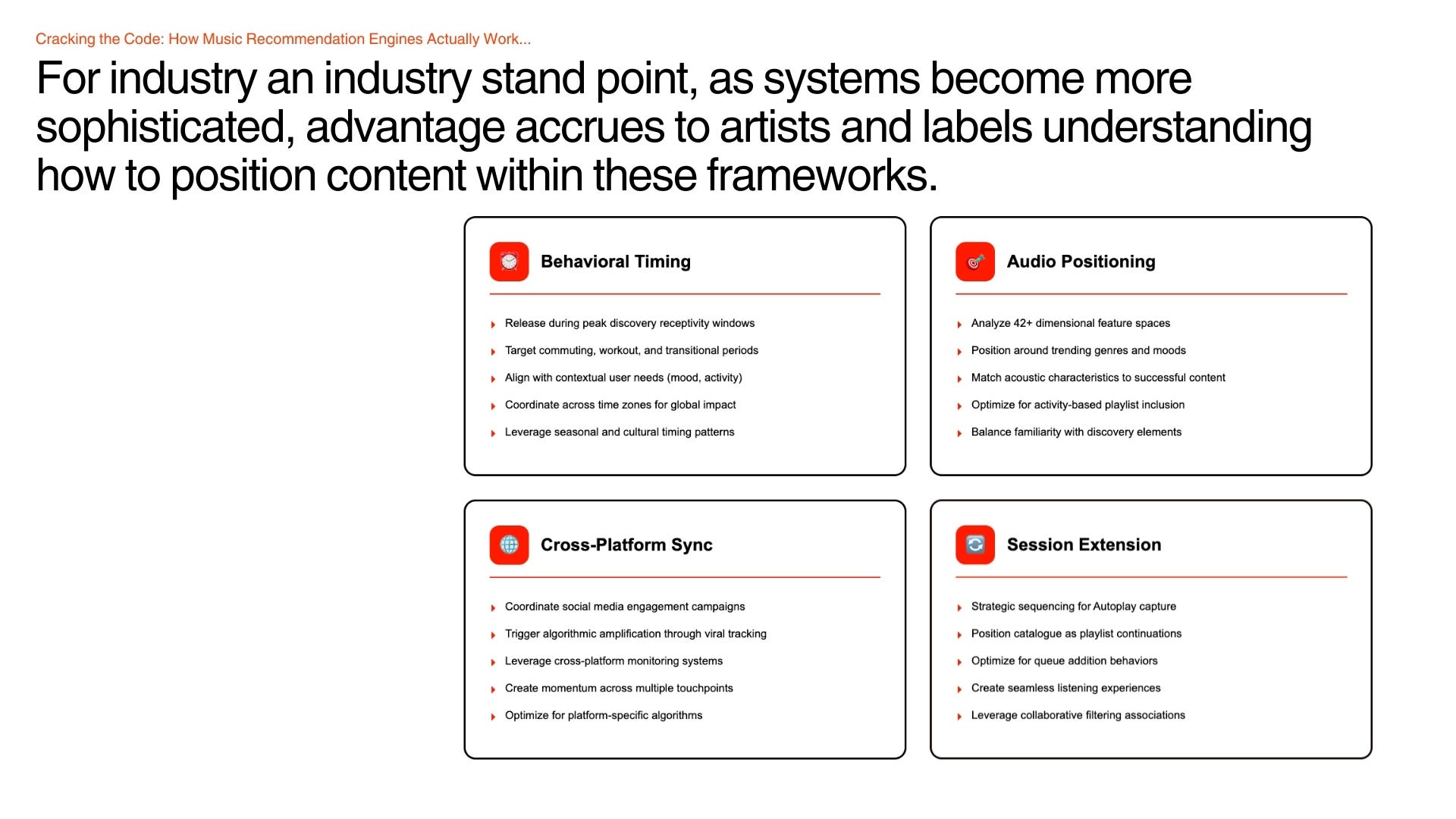
Behavioural Timing Optimisation: Platform temporal analysis reveals when users are most receptive to discovery. Strategic release timing around these windows can significantly impact algorithmic placement.
Audio Feature Positioning: Understanding how catalogue material clusters in platforms' 42+ dimensional audio feature spaces enables strategic positioning around trending genres and moods. This requires technical analysis of your catalogue's acoustic characteristics relative to successfully recommended content.
Cross-Platform Coordination: Platforms integrate social media monitoring and cross-platform engagement in viral tracking algorithms. Coordinated promotion can trigger algorithmic amplification extending far beyond initial campaign reach.
Session Extension Strategy: Understanding that Autoplay drives significant consumption creates opportunities for strategic sequencing. Catalogue tracks working well as playlist continuations can capture engagement from users starting with familiar material.
For industry an industry stand point, as systems become more sophisticated, advantage accrues to artists and labels understanding how to position content within these frameworks.
For Labels: Invest in data analytics capabilities mirroring platform behavioural analysis. Understanding catalogue performance within multi-objective frameworks enables strategic positioning leveraging algorithmic amplification rather than opposing it.
For Artists: Focus on creating music generating strong user engagement signals, (high completion rates, social sharing, playlist additions) rather than optimising solely for play counts. The algorithms reward depth and authentic engagement over superficial metrics.
For Catalogue Managers: Use discovery windows strategically. Dormant catalogue can re-enter discovery algorithms through targeted reactivation campaigns timed around user behavioural patterns and contextual receptivity.
For Promotion Teams: Coordinate across platforms to trigger cross-platform monitoring systems. Social momentum on external platforms feeds back into streaming platforms' algorithmic weighting, creating amplification opportunities beyond individual platforms.
The Strategic Imperative
Music recommendation algorithm’s sophisticated, multi-layered systems optimising for user satisfaction, discovery, and long-term engagement is an impressive feat of computer science, behavioural analysis and curation. The platforms' own research reveals how these systems function and, crucially, how strategic content positioning can leverage algorithmic amplification for catalogue development and audience growth.
The traditional pitch to curators and editors is no longer a viable stand alone strategy; the industry's future success depends increasingly on understanding these systems. As recommendation algorithms assume greater control over music discovery, competitive advantage belongs to those understanding how to work within their optimisation frameworks.
The research exists. The strategic opportunities are clear. The question isn't whether algorithms control music discovery; they demonstrably do. The question is whether industry professionals will develop sufficient technical understanding to use these systems strategically for sustainable catalogue development and authentic fan building.
Article Planning Notes, Resources & References
For a full list of the article planning notes, additional resources & references, please consider becoming a subscriber and join the chat!
